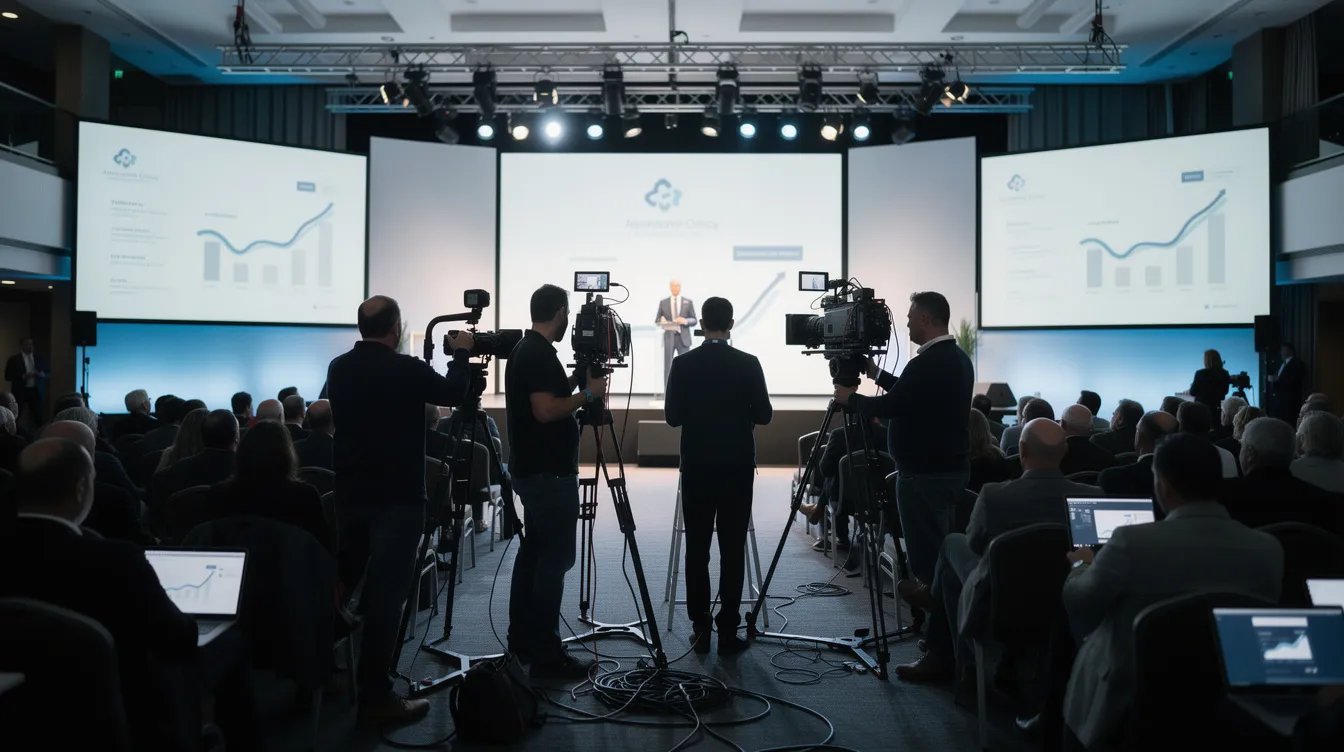
The types of corporate videos businesses use today go far beyond the old "about us" video that lived on a company website and rarely got watched all the way through.
Corporate video is now much more strategic. Video supports sales, marketing, hiring, onboarding, training, investor relations, and internal communications. The challenge is knowing which format fits which goal.
This guide breaks down 10 of the most useful corporate video types, when to use each one, where they belong, and how to prioritize the right mix for your business.
What Are the Main Types of Corporate Videos?
The main types of corporate videos include brand story videos, explainer videos, product demos, customer testimonials, employee testimonials, training videos, internal communications videos, thought leadership videos, event recaps, investor updates, and short-form social videos. The right format depends on your business goal, audience, budget, and where the video will be used.
What Makes a Video "Corporate"?
A corporate video is any professionally produced video created to serve a specific business function. That includes marketing, sales, HR, training, investor relations, and internal communications.
The key word is function. Corporate videos are built around a defined audience and a specific goal. They are not entertainment first. They are not unplanned. Every corporate video exists to do a job.
That also means they live in very specific places. Company websites, sales decks, LMS platforms, LinkedIn, email campaigns, trade shows, board meetings, and internal portals. The distribution channel is decided before the camera rolls, not after.
Why the Type of Corporate Video You Choose Changes Everything

Most companies default to one or two corporate video formats they already know. That leaves real gaps across the buyer journey and inside the organization itself.
Different video types serve different audiences at different moments. Some build awareness with potential customers who have never heard of you. Others educate prospects who are actively comparing options. Some support employees, align distributed teams, or help leadership communicate at scale.
Even a polished video can underperform if it is the wrong format for the goal. Choosing the right mix means your video budget is working across awareness, consideration, decision, and retention simultaneously.
That is the difference between a one-off video and a corporate video strategy.
10 Types of Corporate Videos and When to Use Each
Corporate video categories have expanded well beyond what most people picture. Here is the full range of corporate video formats businesses are using right now, and the specific role each one plays.
1. Brand Story and Company Overview Videos
A brand story video explains who you are, what you stand for, and why it matters. It covers your origin, mission, values, team, and client impact in a format that potential clients and stakeholders can connect with quickly.
This is the video that lives on your homepage, your About page, investor decks, and recruiting pages. It is often the first video a company produces and the one that gets the most mileage across the most channels.
A well produced brand story builds trust before a single sales conversation happens. Real locations, real people, and a clear point of view do more for credibility than any written company description.
Typical length is 90 seconds to 3 minutes. The BrainRobotics brand video is a strong example of how live action and interviews can come together to tell a company story that actually lands.
2. Product Demo and Explainer Videos
Explainer videos and product demos answer the question every potential customer has before they buy: how does this actually work?
Explainer videos simplify complex ideas into a clear, engaging narrative. They work especially well for SaaS platforms, technical products, healthcare solutions, and any offering where confusion is the biggest barrier to conversion.
Product demos go a level deeper. Instead of explaining the concept, they show the product in action. Features, interfaces, workflows, and real use cases. For complex topics, this is often what closes the gap between interest and decision.
Both formats reduce friction in the sales process. They give prospects the clarity they need without requiring a live demo call every time. Wyzowl's 2026 Video Marketing Report found that 96% of people have watched an explainer video to learn more about a product or service before making a buying decision. That is why this format works so consistently across industries.
Animation, live action, screen capture, or a hybrid of all three. Format depends on the product and the audience. Typical length runs 60 to 120 seconds for explainers and 3 to 8 minutes for deeper product demos.
3. Customer Testimonial Videos
Customer testimonial videos let satisfied customers do the talking. And real people saying real things about real results will always be more persuasive than anything a company says about itself.
What makes a testimonial video work is specificity. Not "they were great to work with" but the actual problem the customer had, why they chose this solution, what the experience was like, and what changed afterward. That story structure is what builds trust with potential customers who are still on the fence.
Testimonial videos work hardest at the bottom of the funnel. Pricing pages, landing pages, sales follow-ups, and trade show loops are where they earn their place. A short 60 to 90 second endorsement handles most situations. A longer case study format of 3 to 5 minutes works well when the results need more context to land properly.
Video testimonials also do something written reviews cannot. They capture tone, body language, and genuine emotion. That is what makes them one of the highest converting corporate video formats available.
A customer testimonial is usually shorter and emotion-led. A video case study goes deeper into the problem, solution, implementation, and measurable outcome. Both formats build trust, but case studies are especially useful for complex B2B sales where buyers need proof before they involve leadership or procurement.
4. Employee Testimonial and Culture Videos
Culture videos show what it is actually like to work at your company. Not through slogans or stock footage of people laughing in meeting rooms, but through the real voices of the people on your team.
This format covers employer brand films, day in the life clips, team spotlights, and behind the scenes moments that give candidates and stakeholders a genuine look inside the organization. In a competitive hiring market, that authenticity is what separates companies that attract top talent from companies that struggle to fill roles.
The key is coached, not scripted. Real moments land harder than polished performances. Give team members direction and let them speak naturally. That is what potential employees actually want to see.
Ideal placement is your careers page, LinkedIn job posts, onboarding portals, and internal referral campaigns.
5. Training and Onboarding Videos
Training videos give new employees and existing staff a consistent, repeatable way to learn. No more relying on one person to deliver the same information over and over. The video does that job at scale.
Onboarding videos specifically help new hires get up to speed faster. Company culture, internal processes, tools, systems, and role specific expectations can all be covered before someone even walks in the door. That reduces time to productivity and takes pressure off HR and team leads.
For learning and development teams, training videos also mean better knowledge retention. People engage more with video content than they do with long PDFs or static slides. And when a process changes, a well structured modular video is far easier to update than retraining an entire team from scratch.
These videos live in LMS platforms, intranets, customer academies, and knowledge bases. Keep modules short, focused, and easy to navigate.
6. Internal Communications and Town Hall Videos
Internal communication videos help leaders share updates, new policies, milestones, and important announcements without scheduling another company wide meeting.
For distributed and hybrid teams, this format is especially valuable. A recorded video delivers the same message to every team member across every time zone with no scheduling conflicts and no information getting lost in translation. People can watch it when it works for them and come back to it when they need to reference something.
The format scales with the stakes. High stakes announcements like organizational changes or major pivots benefit from professional production. Weekly leadership check ins can be simpler. What matters most is that the message is clear, direct, and human.
These videos live on intranets, Slack, email, and internal portals. They are one of the most underutilized corporate video formats, especially for companies managing remote or global teams.
7. Thought Leadership and Executive Communication Videos
Thought leadership videos position your executives and subject matter experts as credible voices in your industry. Not as vendors. As people worth listening to.
A great example is a CEO speaking to where the industry is heading, or a subject matter expert breaking down a complex topic that their target audience is actively searching for. The focus is useful insight, not a sales pitch. That distinction is what makes this format work.
These videos perform well on LinkedIn, company blogs, conference decks, and PR outreach. They reach senior buyers, industry peers, investors, and media in a way that promotional content simply cannot.
For B2B companies especially, thought leadership video builds the kind of long term credibility that shortens sales cycles.
Formats include recorded keynotes, podcast style interviews, panel excerpts, and LinkedIn video series.
8. Event Recap and Conference Highlight Videos

Event videos capture the best moments from conferences, trade shows, user summits, and company gatherings. But their real value is what happens after the event ends.
A single well produced event recap extends the life of a one day event into months of content. Highlight reels, speaker soundbites, attendee reactions, sponsor activations, and behind the scenes footage all become assets for future events, social media, email campaigns, and sales outreach.
Pre-event teasers build anticipation. Live capture documents the energy in the room. Post event highlight reels give people who attended a reason to share and people who did not a reason to show up next time.
High energy footage, compelling visuals, and the right music can turn what felt like a fleeting moment into a lasting impression for your brand. Same day social cuts released within 24 hours keep the momentum going while the event is still relevant.
For companies that invest in live events, video is what makes that investment compound over time.
9. Investor and Stakeholder Update Videos
Investor relations videos help boards, shareholders, and strategic partners understand where the business stands and where it is going. They replace dense written reports with something people will actually watch and retain.
Common use cases include quarterly performance recaps, annual meeting openers, M&A announcements, and roadmap walkthroughs. The audience is sophisticated and time pressed, so the format needs to be data driven and direct.
Tone matters here more than in almost any other corporate video category. Professional and transparent, not promotional. Lead with the numbers, support with executive commentary, and let the results tell the story. Stakeholders are not looking for hype. They are looking for clarity and confidence.
Motion graphics work well for visualizing revenue data and market metrics. Live action executive messages add the human element that written investor updates lack. The combination of both tends to land best.
10. Social Media and Short-Form Corporate Videos
Short form social media videos are not always a standalone production. The smartest way to approach this format is to plan for it before any other shoot begins.
A well planned brand film, event capture, or testimonial session can generate 8 to 12 social ready clips in both vertical and landscape formats. That means one production day produces content that fuels weeks of posting across LinkedIn, Instagram, YouTube Shorts, and email campaigns.
What makes this format work on social is different from what makes a brand film work on a website.
For B2B companies, LinkedIn is where short form corporate video drives the most measurable impact. Quick product tips, founder soundbites, customer quote clips, behind the scenes moments, and event highlights all perform well when the content feels native to the feed rather than repurposed from somewhere else.
The goal is not to boost engagement for its own sake. Every clip should connect back to a business objective and point viewers toward the next step.
How to Prioritize the Right Types of Corporate Videos for Your Business

Start with the business goal, not the format. That is the single most important shift in thinking when building a corporate video strategy.
Here is a simple starting map based on common business objectives:
- Lead generation: explainer videos and customer testimonials
- Brand awareness: brand story videos and social media clips
- Talent acquisition: culture videos and employee testimonials
- Internal alignment: training videos and internal communications
- Investor confidence: stakeholder update videos and brand films
- Revenue acceleration: product demos and video case studies
Early stage companies usually need an explainer and one or two testimonials first. Scaling companies add a brand story, thought leadership, and product videos. Enterprise teams typically need the full stack across marketing, HR, training, and internal communications.
The other variable is budget. You do not need all 10 formats at once. Build the library progressively, starting with the videos that directly support your biggest current bottleneck.
Mapping Corporate Video Types to the Buyer and Employee Journey
Not every video serves the same moment. Here is how the 10 types map across the full funnel:
- Awareness: brand story videos, thought leadership, and social media clips reach people who do not know you yet and build credibility before any sales conversation starts.
- Consideration: explainer videos, product demos, and customer testimonials answer the questions prospects are actively asking when they are comparing options.
- Decision: case study videos, investor updates, and detailed product walkthroughs give procurement teams and senior decision makers the proof they need to move forward.
- Retention and internal alignment: training videos, onboarding content, internal communications, and culture videos serve the people already inside your organization or already using your product.
What Every Corporate Video Has in Common
Across all 10 formats, the corporate videos that actually perform share the same foundation.
One defined audience. One clear message. One specific next step. Most people do not need more information. They need the right information, delivered clearly, at the right moment.
Every strong corporate video also has a distribution plan decided before production begins. Where it lives, who sees it, and what action it drives are not afterthoughts. They are part of the brief.
The other thing the best corporate videos share is repurposability. A hero video, short social clips, email cuts, sales deck versions, and website edits can all come from a single well planned production day. That is what makes video a compounding asset rather than a one time expense.
And above everything else, strategy beats gear. The brief, the story, the script, and the call to action matter more than the camera.
What to Expect from a Professional Corporate Video Partner
A strategy first production partner does more than show up and shoot. The process should start with discovery: understanding your business goals, your audience, your message, and where the video will live before anyone picks up a camera.
From there, a strong production process moves through brief, script, production, post production, and delivery with clear checkpoints and stakeholder review built in.
The other thing worth looking for is a partner who thinks in assets, not videos. One shoot day can produce a homepage hero video, sales clips, social cuts, internal updates, and recruiting content. That approach makes corporate video production significantly more efficient and gives your team more to work with across more channels. The business case for video holds up too: according to HubSpot's State of Marketing Report, 93% of marketers say video is an important part of their overall strategy.
Costs vary by scope and format:
- Professional live action brand films typically run between $8,000 and $30,000
- Internal executive communication videos generally fall between $3,000 and $16,000
- Training modules range from $5,000 to $16,000 per module
- Event videos run $6,000 to $25,000 depending on crew size, duration, and deliverables
Understanding the full scope of corporate video production helps to ask the right questions when looking for the right corporate video production company to partner with
Build the Right Corporate Video Library for Your Business
The right mix of corporate video formats does more than fill a content calendar. When you understand the different types of corporate videos and what each one is meant to do, video becomes a more strategic asset for sales, marketing, recruiting, training, and internal alignment.
The companies seeing the strongest results from video are not producing more content. They are producing the right content for the right audience at the right stage of the journey.
If you are ready to build a corporate video strategy around real business goals, Levitate Media has 16 years of experience helping companies across tech, healthcare, finance, manufacturing, and professional services do exactly that.
Explore our work in the Levitate Media portfolio or get a quote to start scoping your next project.
Check Out Related Content
🌐 Corporate Video Statistics [2026]: Data on Business Video Investment and Impact
🌐 Best Corporate Video Production Companies 2026
🌐 Corporate Video Production Rates: 2026 Pricing Guide by Video Type
Insights from