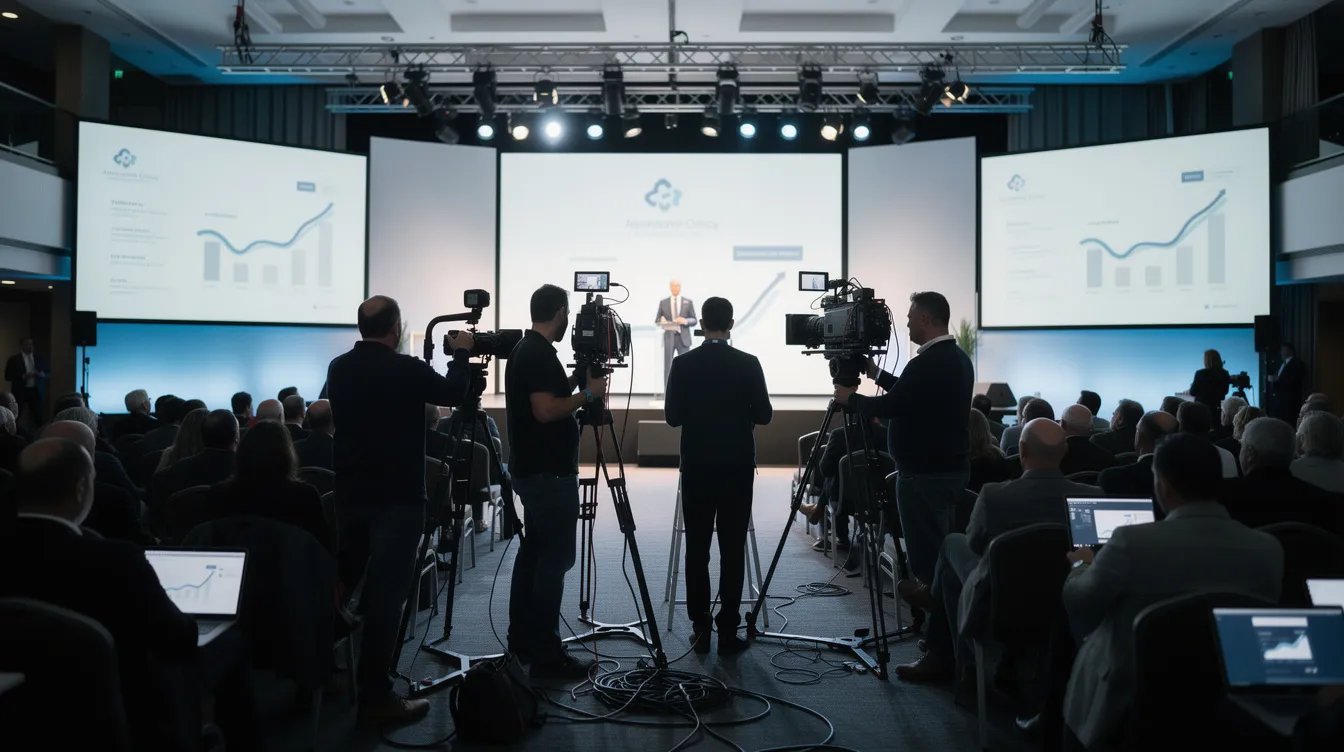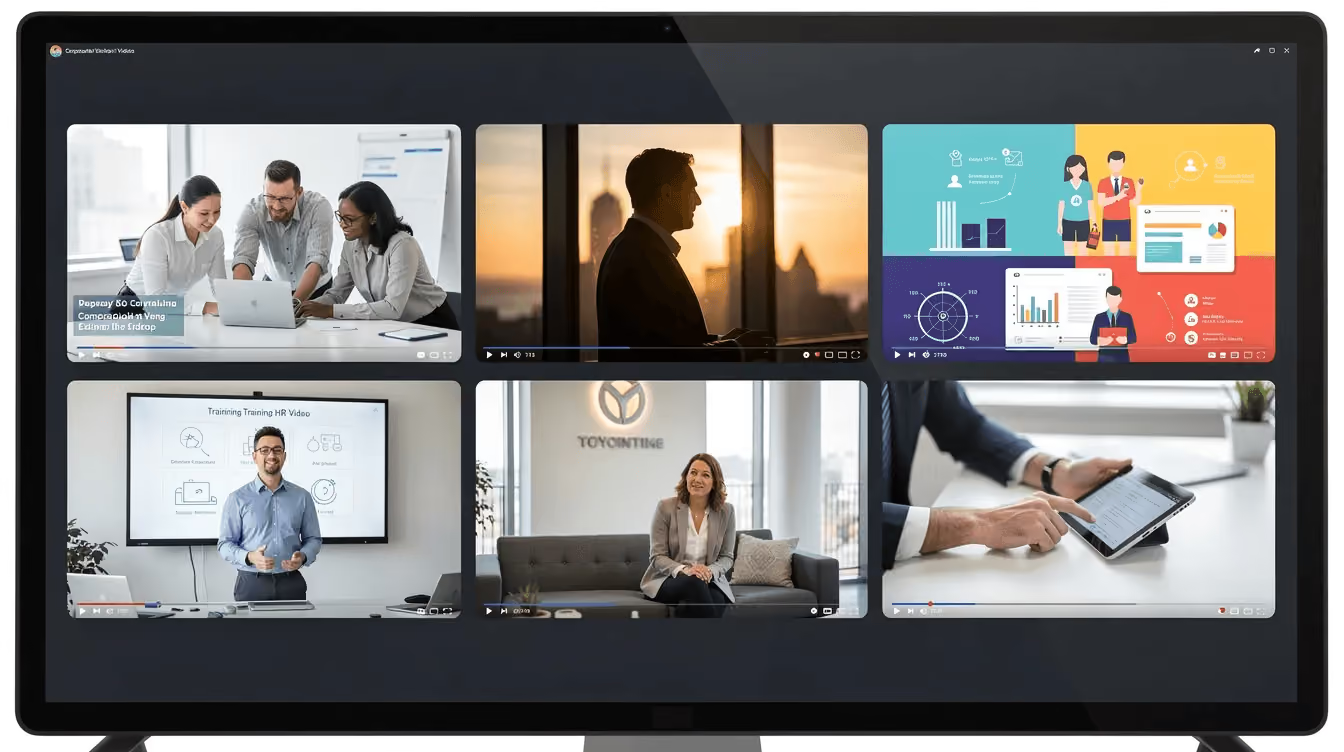

Corporate video has moved to the center of how enterprises train employees, communicate strategy, build culture, and close B2B deals. Large organizations that once treated production as a periodic line item now run continuous video programs across internal communications, employer branding, B2B marketing, and executive content. The data below reflects that shift.
The statistics below are drawn from enterprise surveys, agency pricing benchmarks, and primary industry research. Each is individually sourced and linked. Whether you are building a business case for corporate video production, benchmarking an existing program, or presenting budget requests to leadership, these numbers give you the data to do it with confidence.
Key Takeaways
Before diving into the full data set, here are six figures that frame the current state of corporate video investment:
- 91% of businesses now use video as a marketing tool, an all-time high since tracking began in 2016 (Wyzowl)
- 87% of enterprise respondents say video delivers positive ROI across knowledge sharing, communications, and creativity (Kaltura)
- 59% of senior B2B executives prefer watching video over reading text when evaluating a product or service (Forbes Insights)
- 84% of large enterprises use video for corporate communications including town halls and executive messaging (Kaltura)
- 50% reduction in cost-per-hire for companies that invest in employer brand video content (Glassdoor)
- A professionally produced 2-to-3 minute corporate video typically costs $5,500 to $20,000+, depending on production approach (Levitate)
Section 1: Corporate Video Adoption
Corporate video adoption has grown consistently across every company size and sector. The numbers below reflect where enterprise behavior actually sits today.
Stat 1. 91% of businesses use video as a marketing tool, the highest level recorded since Wyzowl began tracking this metric in 2016, when adoption stood at just 61%. (Wyzowl State of Video Marketing)
Stat 2. 87% of enterprise respondents say video offers a positive return on investment by improving knowledge sharing, communications, and employee creativity. (Kaltura State of Video in the Enterprise)
Stat 3. 66% of enterprises report an increased budget allocation for video technologies year over year, and 64% report watching more work-related video this year than last. (Kaltura State of Video in the Enterprise)
Stat 4. 75% of employees report that their organizations are actively encouraging them to produce more videos for business purposes. (Kaltura/IntelliVid Research, State of AI Video in the Enterprise)
Stat 5. 69% of companies use video for employee training and learning. Among large companies specifically, that figure rises to 89%. (Kaltura State of Video in the Enterprise)
Stat 6. Brand awareness is the most common external video use case, with 62% of companies using video in this capacity. Among large companies, the figure reaches 73%. (Kaltura State of Video in the Enterprise)
Stat 7. 75% of enterprise respondents say integrating video into existing enterprise tools is important, and 70% say there is value in a standalone internal video portal for centralized storage and discovery. (Kaltura)
Stat 8. Nearly all enterprise video users (93%) report using video across multiple internal and external use cases simultaneously, with 10% using it for more than nine distinct purposes. (Kaltura State of Video in the Enterprise)

Section 2: Corporate Video for Internal Communications
Internal communications is where corporate video tends to deliver its most measurable per-employee impact. The data below covers training effectiveness, employee preference, information access, and retention outcomes.
Stat 9. Employees are 75% more likely to watch a video than to read documents, emails, or web articles. (Forrester Research, cited via Panopto)
Stat 10. More than two-thirds of employees say they would rather use video to learn a new task than rely on written instructions - and this preference holds across every generation in the workforce, not just younger employees. (Kaltura State of Video in the Enterprise)
Stat 11. 59% of all companies use video for corporate communications such as town halls, recorded executive messages, and initiative launches. Among large enterprises, that figure reaches 84%. (Kaltura State of Video in the Enterprise)
Stat 12. 60% of employees report difficulty getting the information they need to do their jobs well. Searchable, on-demand video libraries built around internal knowledge directly address this gap. (Panopto Workforce Knowledge Research)
Stat 13. 70% of employees say learning and development opportunities improve their connection to their company. (LinkedIn research, cited via Panopto)
Stat 14. 76% of employees say they are more likely to stay at a company that offers continuous training and development. (SHRM, cited via Panopto)
Stat 15. Organizations that adopt video as their primary training method and integrate it into digital learning programs see up to a 218% increase in revenue per employee compared to organizations without structured video learning programs. (Panopto research, cited via Intuition)
Stat 16. More than two-thirds of employees admit to skimming through training videos, indicating that video format, duration, and structure matter as much as the decision to use video at all. (Kaltura interactive video survey)
Production quality and structure drive completion. If the content is poorly paced or overlong, employees disengage - and the business case for internal video erodes with them. This is where working with an experienced corporate video production team makes the operational difference.
Section 3: Corporate Video for External Marketing
The B2B buying process has fundamentally changed. The majority of research now happens before a prospect ever contacts a vendor. Video plays a direct role in what buyers find, how they evaluate options, and how fast they decide to act.
Stat 17. 59% of senior B2B executives prefer watching video over reading text when learning about a product or service. (Forbes Insights)
Stat 18. 50% of B2B buyers watch video content to help them make purchase decisions. (Demand Gen Report, cited via The B2B House)
Stat 19. 56% of B2B buyers consult customer testimonials during the purchase process. Video testimonials outperform text-based reviews in direct purchase influence. (Famewall analysis of B2B purchase behavior)
For more on how employee and customer testimonial videos function within B2B sales cycles, the data is consistent: peer proof on screen moves buyers faster than any marketing-produced content.
Stat 20. 64% of viewers say they are more likely to purchase a product after watching a video testimonial. Enjoying a video can improve purchase intent by up to 97%. (Famewall Video Testimonial Statistics)
Stat 21. 69% of B2B marketers planned to increase their investment in video YOY, the largest planned increase among all content formats tracked. (Content Marketing Institute Annual B2B Content Marketing Survey, cited via Scribewise)
Stat 22. 80% of B2B businesses that use video for marketing report positive ROI from that investment. 73% report positive ROI specifically after integrating video into their full marketing strategy. (Famewall)
Stat 23. 86% of B2B buyers say content has accelerated their purchase decisions, and 64% say it has led them to request a demo. (Scribewise multi-national B2B buyer survey)
Stat 24. Video drives a 157% increase in organic traffic from search engine results pages when added to corporate pages and career sites. (Brightcove, cited via Aspiration Marketing)

Section 4: Recruitment, Employer Branding, and Culture Video
Culture video and employer branding content are frequently treated as soft investments with soft outcomes. The data below shows the opposite. Employer brand video has direct, measurable consequences for cost-per-hire, application volume, and offer acceptance rates.
Stat 25. 83% of job seekers research a company's reviews and ratings before deciding where to apply. (Glassdoor)
Stat 26. Companies with a strong employer brand can reduce cost-per-hire by 50% and lower employee turnover by 28%. (Glassdoor / LinkedIn Talent Solutions)
Stat 27. 72% of global recruiting leaders agree that employer brand significantly impacts their ability to hire. 80% say it significantly affects their ability to attract quality candidates. (LinkedIn Global Recruiting Trends)
Stat 28. Companies with a positive employer brand receive twice as many applications compared to those with a negative or absent brand perception. A strong employer brand also increases the number of qualified candidates by 50%. (LinkedIn)
Stat 29. 70% of Glassdoor users say they are more likely to apply to a job if the employer actively maintains its Glassdoor presence - which increasingly includes video content as a primary format. (Glassdoor)
Stat 30. 88% of job seekers consider a company's employer brand when deciding whether to apply for a role. (LinkedIn)
Culture videos and day-in-the-life content serve a specific and high-leverage role in this process. They give candidates the unscripted proof that a job description never can. When employer brand video and corporate videography strategy are aligned, the recruiting ROI is not marginal - it is structural.
Section 5: Corporate Video Production and Budget
Production cost data is frequently misrepresented in both directions: agencies overstate the low end to win budget conversations, and buyers underestimate real scope requirements. The benchmarks below reflect published agency rate data and primary survey findings.

Stat 31. Corporate video production costs range from $1,000 to $10,000 per finished minute, depending on crew size, talent, location, and post-production complexity. (Clutch agency pricing survey, cited via Colossyan)
Stat 32. A professionally produced 2-to-3 minute corporate explainer video typically costs between $4,500 and $20,000 depending on production approach - whether that means a single-camera setup with basic editing or a full crew with professional talent and custom graphics. (Vidico production cost benchmarks)
Stat 33. The average full agency video project costs approximately $42,000, covering the full range from 30-second social clips to 10-minute brand films. (Clutch agency survey, cited via Colossyan)
Stat 34. 55% of video marketers create their content in-house, 14% outsource to external vendors, and 31% use a hybrid of both. (Wyzowl State of Video Marketing, cited via Goldcast)
For most organizations, the 31% hybrid model reflects reality. In-house teams handle day-to-day social and internal content; external production partners own the flagship brand, sales, and testimonial formats where production quality directly affects perception.
Stat 35. Subscription-based video production reduces per-asset cost by 30-40% compared to per-project pricing, because fixed costs are distributed across a larger volume of deliverables. (Vidico production model analysis)
Stat 36. One in three brands is now using AI tools to create videos faster. Organizations that use AI-infused video tools are 4.5 times more likely to increase their overall video output compared to those using standard tools. (Wyzowl; Kaltura/IntelliVid Research State of AI Video)
Stat 37. 18% of businesses currently leverage AI specifically for video content production. Auto-generating captions and transcripts is the most common AI use case, adopted by 59% of AI video users. (Wistia State of Video Report, cited via HubSpot)
The AI adoption curve in corporate video is accelerating fast, but it is not yet a replacement for professional production on formats where brand perception is at stake. AI is most effective at reducing the cost of volume content - internal communications, short-form social, training modules - while human-led production remains the standard for testimonials, brand films, and executive storytelling.
See What Corporate Video Looks Like When It Is Built Right
Levitate Media works with companies to build corporate videos that pack a punch - testimonial films, brand video, internal communications, and executive content. We handle strategy, production, and delivery. You get a consistent volume of high-quality video without managing a production crew.
Contact us to scope your project and we will give you a straight answer on timeline, cost, and fit.
Insights from