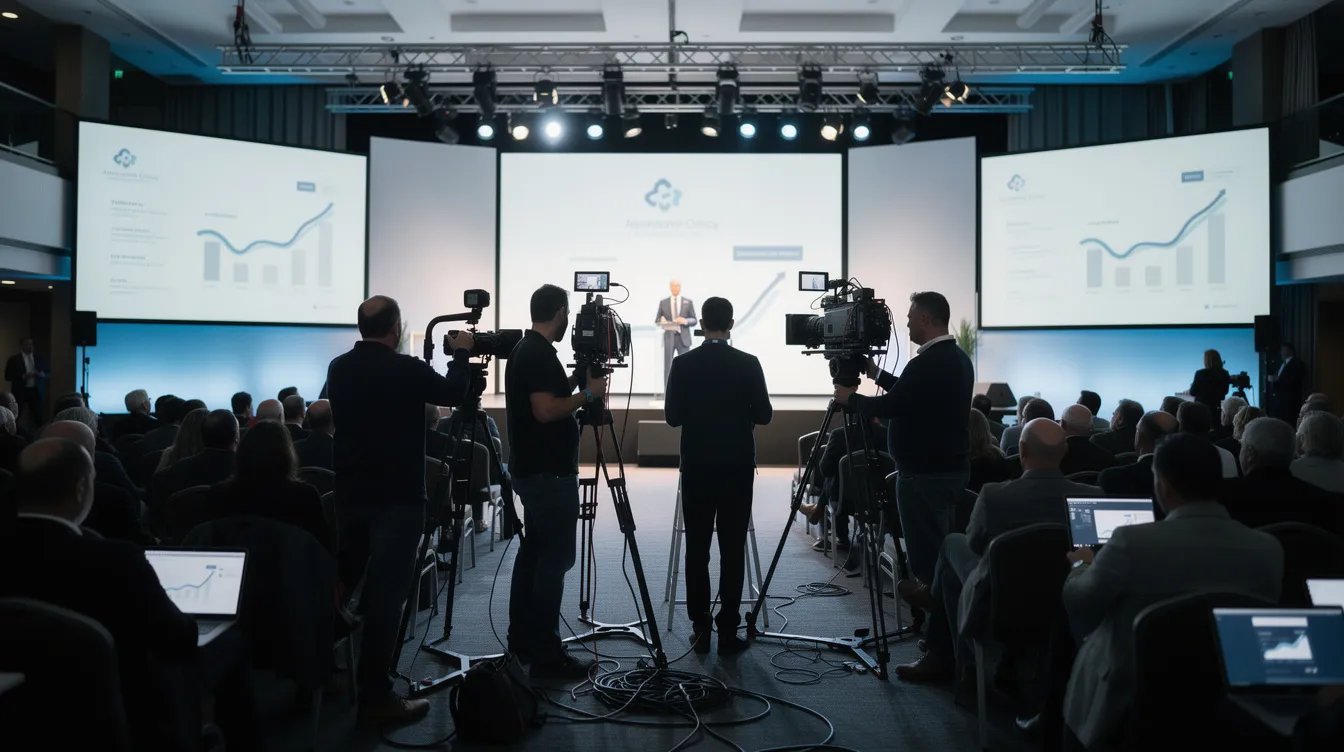
Multi-asset video production is how smart marketing teams get more out of every video dollar they spend. Instead of producing one video at a time, you plan a single shoot to generate multiple assets, each with a clear role, a defined target audience, and a place in your video marketing strategy.
The pressure to produce more video content is real. Websites, sales decks, social platforms, and internal channels all need video. But budgets are not growing at the same pace.
Without a plan for how footage gets used after the shoot, files pile up, content gets duplicated, and teams end up recreating work that already exists. Your video ROI suffers as a result.
This guide covers how to build a multi-asset video strategy that improves workflow efficiency, supports lead generation, and helps businesses maximize the ROI of video from every production investment.
Why This Topic Matters

Video content is expected everywhere in the organization now. Marketing uses it for demand generation. Sales uses it to explain value. HR and product teams use it to communicate at scale.
The problem most teams run into is not creating video. It is managing video after it exists.
Files scatter across drives and inboxes. Version control breaks down. Teams spend time hunting for assets that should take seconds to find. The result is wasted budget, duplicated effort, and video content that underperforms because it was never set up to scale.
Modern consumers interact with video across every digital channel. When your video marketing efforts are fragmented, you lose the compounding effect that an organized, multi-asset approach delivers.
One shoot, planned correctly, can support multiple video campaigns across digital channels without additional production days or ballooning video production costs. That is where positive video marketing ROI starts to build.
Step-by-Step Approach to Multi-Asset Video Campaigns
A successful multi-asset video campaign does not happen by accident. It requires a clear workflow that connects strategy, production, and distribution from the start.
Step 1: Define Your Objectives First

Every multi-asset production effort should begin with clear business objectives. This sets direction for the entire campaign and prevents wasted budget down the line.
Without defined goals, video projects expand quickly but deliver uneven results. Clear objectives help teams align on:
- The primary business goal, such as increasing brand awareness, conversion, sales enablement, or internal clarity
- The specific videos required to support that goal
- Target formats and platforms where those assets will live
- How video marketing ROI will be measured beyond view counts
When everyone understands why each asset exists, it becomes easier to manage version control, apply metadata, and keep files organized. Without this clarity, video creation often leads to more content but fewer measurable business outcomes.
Step 2: Know Your Target Audience and Plan Formats Accordingly

Multi-asset production only works when assets are designed for the people who will actually use them. Different audiences consume video content differently, even when the core message stays the same.
- Marketing teams need short, high-impact clips for social platforms and paid video campaigns
- Sales teams rely on longer assets that clearly explain value and support conversations with potential customers
- Internal teams benefit from concise videos focused on clarity and consistency
Aligning video assets to your target audience and funnel stage directly affects conversion rates, customer engagement, and lead generation, according to HubSpot's video marketing research. This approach works especially well when businesses use explainer videos or B2B explainer videos to support education and reuse across platforms without recreating content from scratch.
Step 3: Structure the Production Process for Scale

Scalability is built in before filming starts, not added later during editing.
Scripts are written to support multiple assets from the beginning. Shoots are planned to capture variations, supporting shots, and usable soundbites across formats. This gives production teams flexibility in post-production without stretching footage beyond its purpose.
After filming, video files move through a defined review and approval process. Team members need to know which assets are final, approved, and ready for distribution. Without that structure, files become unmanageable and slow the entire team down.
Ownership matters here too. Teams need clarity around who approves assets, who can reuse them, and which versions are safe to distribute. When that governance is unclear, even high quality production loses value over time.
Step 4: Use Real Examples to Guide Asset Planning
Customer testimonials are one of the most efficient assets to produce this way. One interview session can generate a long-form case study, a 60-second sales asset, and a short social proof clip, all from the same shoot day.
The same footage gets reused across platforms while staying consistent in message and quality. When customer testimonial videos live in one organized system, teams can access approved content quickly and reuse assets without repeating work.
This is also where audience engagement compounds. Viewers interact with authentic customer stories on an emotional connection level that polished brand content rarely achieves. A single well-produced testimonial can support email marketing campaigns, landing pages, and sales outreach simultaneously.
Step 5: Build Video SEO Into the Production Workflow

Multi-asset video production only delivers long-term value when assets are easy to find, both internally and in search.
Video SEO should be part of the production workflow from the start, not something added after launch. Each asset should be created with discoverability in mind.
Practically, this means:
- Writing clear, keyword-aligned titles for every asset before it goes live
- Using consistent file naming conventions that reflect content and format
- Adding accurate metadata and tags so assets are searchable inside your content system and across distribution channels
- Structuring video content around how your target audience actually searches
Assets built for websites, YouTube, or content hubs perform better when they align with search intent. A well-optimized video supports website traffic, improves search engine ranking, and helps your content show up where potential customers are already looking.
Proper tagging and metadata also protect search rankings over time. As your video library grows, a well-organized system means assets stay findable and keep generating value rather than getting buried.
Step 6: Track the Right Metrics to Measure Video Marketing ROI
Every asset needs a defined success metric before the shoot happens, not after. Without that, teams default to video views, which tell you almost nothing about real business outcomes.
Match the right metrics to the goal:
- Awareness assets: watch time, audience retention, website traffic, search engine ranking, brand lift
- Lead generation videos: click through rate and leads generated
- Sales enablement assets: deal velocity and audience insights from reps on what they actually use
- Customer testimonials: conversion rates on pages where they live
- Video ads and paid campaigns: ad spend efficiency, campaign costs, and view-through conversion rates
Google Analytics and UTM parameters connect specific assets to real traffic and conversion data. YouTube Analytics goes deeper, surfacing audience engagement patterns, viewer behavior, and watch time trends that give you valuable insights for data driven decisions.
Analytics tools like Vidyard or Wistia add another layer, showing exactly where viewers interact with individual videos and where they drop off. This kind of data analysis helps you understand user behavior and make smarter production decisions going forward.
The goal of roi measurement is not to collect numbers. It is to understand which assets are generating leads, supporting direct sales, and delivering positive ROI so your next investment is sharper than the last.
Step 7: Repurpose Content Across Channels and Formats

This is where multi-asset production delivers its biggest return on investment.
One shoot, planned correctly, can produce a long-form website video, short social clips, a sales enablement asset, email marketing content, and supporting material for video ads. Every asset serves a specific purpose while reinforcing the same core message across digital channels.
The key word is planned. Repurposing only works when it is built into the production workflow from the start. Footage shot without repurposing in mind rarely cuts down cleanly into other formats.
A centralized asset library with clear metadata, tagging, and file naming is what makes this sustainable at scale. Without it, teams spend more time hunting for files than using them.
Tracking links and UTM parameters help you measure the roi across every channel where assets are distributed. This connects your video marketing efforts to real business outcomes, from generating leads to supporting direct sales at trade shows, in email marketing sequences, and across paid campaigns.
This planning-first mindset is central to how Levitate Media approaches video marketing strategy. Content is mapped to channels and outcomes before production begins, so every asset has a job to do from day one.
Common Mistakes That Kill Your Video Marketing Campaigns and ROI
Even well-planned video marketing campaigns fall apart in predictable ways. Here are the ones worth avoiding.
- Treating repurposing as a post-production task. If the shoot was not planned for multiple formats, the footage will not cut down cleanly. You end up with compromised assets or expensive reshoots that inflate campaign costs.
- No centralized system for assets. Files scattered across drives and inboxes mean teams waste time searching, duplicate work, and distribute outdated versions without realizing it. This directly hurts video performance and brand recognition.
- Skipping version control. When there is no clear record of what is final and approved, the review process breaks down and projects stall.
- Measuring success with video views alone. Video views are easy to report but rarely connected to revenue generated, leads generated, or sales conversions. If your key performance indicators stop at views, you are optimizing for the wrong thing. Focus on the right metrics that reflect actual business outcomes.
- Producing without a distribution plan. A great video that no one sees delivers zero ROI. Distribution should be mapped before the shoot, not figured out after delivery. This is especially true for video marketing campaigns designed to boost customer video engagement across multiple channels.
Measuring Video ROI Beyond Views

Views are a starting point, not a success metric. Vidyard reports that using video in sales conversations helps teams shorten the sales cycle by improving clarity and reducing back-and-forth during the decision process.
Here are the key metrics worth tracking.
- Asset usage across teams
Are sales, marketing, and product teams actively pulling from the video library, or are files sitting untouched? Low usage usually means assets are either hard to find or not built for the right use case. This is valuable direct feedback on whether your video strategy is working. - Workflow efficiency
Is your team producing more video content without video production costs scaling at the same rate? That gap is where multi-asset production pays off. - Funnel movement
Are specific videos moving potential customers from awareness to consideration? Are they shortening sales conversations? Video in sales outreach measurably improves response rates and supports direct sales at every stage of the funnel. - Content longevity
Are assets being reused across video marketing campaigns and digital channels over time, or replaced after a single use? Long-lived content is a sign the strategy is working. - Direct business outcomes
Leads generated, sales conversions, revenue generated, and brand lift from specific video campaigns are the engagement metrics that justify continued investment. These are the success metrics that build the internal case for scaling your video marketing efforts.
To calculate roi accurately, use the roi formula: revenue generated from video minus cost of video, divided by cost of video, multiplied by 100. Pair that with Google Analytics data, UTM parameters, and audience insights from your analytics tools to get deeper insights into how viewers interact with your content across every channel.
If you are evaluating video production costs against these outcomes, the math changes significantly when one shoot produces ten assets instead of one.
Conclusion
When video is planned with distribution, reuse, and roi measurement in mind, the return on every shoot compounds. Teams produce more without spending more. Assets stay organized and accessible. And video stops being a line item that is hard to justify and starts being a growth driver with clear, trackable business outcomes.
The companies getting the most from their video marketing efforts are not necessarily spending more. They are planning smarter, shooting with purpose, and building video libraries that work across the full funnel, from increasing brand awareness at the top to supporting sales conversions at the bottom.
Measuring video marketing ROI does not have to be complicated. Define your goals, track the right metrics, use analytics tools to collect data, and let the results guide your next production investment.
If you are ready to get more from your video production budget, talk to the Levitate Media team. With 16+ years of experience and 10,000+ videos produced, we help businesses build video strategies that deliver measurable results across every channel.
Get a video budget estimate and see what a single well-planned shoot could produce for your business.
At Levitate Media, we help teams turn a single video shoot into a full content ecosystem. If you are evaluating video as a growth investment and want guidance from a team that has done this at scale, talk to a Levitate Media video expert.
Insights from