B2B buyers do their homework long before they talk to sales. Most of them have already watched video content, compared solutions, and formed an opinion about your company before anyone picks up the phone.
That is the reality of modern enterprise buying. And it is exactly why B2B video marketing has become a core part of how serious marketing teams operate.
Good video content gives potential customers a faster first glance at what you do, why it matters, and whether your solution helps their business. The best B2B video strategies support marketing, give sales teams better tools, shorten buying cycles, and help customers see value faster.
This guide breaks down how to build a B2B video strategy that works across every stage of the sales funnel, from first touch to closed deal.
Why B2B Video Marketing Works Differently Than B2C
B2B video works because the buying process is slower, more cautious, and more collaborative. You are rarely talking to one viewer. You are speaking to decision makers across finance, IT, operations, and leadership, all evaluating the same solution from different angles.
That changes everything about how you create content. A CFO wants proof of return on investment. A technical evaluator wants integration details. An operations leader wants to see workflow benefits. Your target audience is really a buying committee, not a single buyer.
And trust is everything in that process. According to Brightcove, 93% of B2B buyers find video important in building trust in a brand. That is not a small number. It means video is one of the most direct ways to earn credibility with a group of people who are cautious, informed, and skeptical by default.
That is where a B2B video marketing strategy has to do more than entertain. It has to build clarity, proof, and confidence over the course of a long deal cycle. A strong marketing video makes complex ideas feel simple. Written content supports the details. Video carries the story.
Mapping B2B Video Types to the Buyer Journey

Each video format should have a job. Some videos create awareness. Others answer objections. Some help close deals. The right video types depend on where your buyer is in the journey, what their pain points are, and what decision stage they are in.
Here is how it breaks down across the funnel:
- Awareness: Brand videos, thought leadership clips, and short social videos build reach and trust before a prospect ever talks to sales.
- Consideration: Explainer videos, product demos, and webinars do the heavy lifting of education and comparison.
- Decision: Testimonial videos, case studies, and proposal videos give buying committees the proof and risk reduction they need to move forward.
- Post-Purchase: Onboarding and training videos drive faster adoption and set the foundation for expansion revenue.
Every stage needs different video content. The mistake most B2B teams make is producing one hero asset and calling it a strategy. A real B2B video marketing strategy covers the full funnel, with each video type playing a specific role in moving buyers forward.
Awareness Stage: Thought Leadership and Brand Videos
At the top of the funnel, your goal is simple: get the right people to notice you and trust you enough to keep paying attention.
A brand video does that by telling your story, communicating your values, and showing prospects why your company exists and who it serves. It does not need to sell anything. It just needs to make the right buyer feel like they are in the right place.
Short thought leadership clips work well here too, especially on LinkedIn. B2B buyers scroll through their feeds between meetings, often with the sound off. A 30 to 60 second clip with strong captions and one clear idea can do more for awareness than a long post ever will.
The key at this stage is consistency. One video does not build awareness. A steady cadence of relevant, well-positioned video content does.
Consideration Stage: Explainer Videos and Product Demos
This is where buyers get serious. They know they have a problem. Now they are comparing solutions and trying to figure out which one actually fits their business.
Explainer videos are ideal here. If your offer is hard to explain in one sentence, a well-crafted 60 to 90 second animated or mixed-media explainer can do the work that a landing page paragraph never quite manages. It gives potential customers a clear picture of what you do, how it works, and why it matters for their specific situation.
Product demos go a step further. They show the actual product in action, walking through real workflows and key features. For SaaS platforms and complex services, a good product video can answer the questions that would otherwise take three sales calls to resolve.
Webinars serve a different purpose at this stage. They give buying committees a chance to go deep on a topic, ask questions in real time, and hear from subject matter experts. They are especially useful when the decision involves multiple stakeholders who all need to feel confident before moving forward.
Decision Stage: Case Studies, Testimonials, and Proposal Videos
At this stage, the buyer is not looking for more information. They are looking for proof.
Testimonial videos are one of the most powerful tools you have here. A real customer, on camera, talking about a specific result they achieved with your help carries more weight than any marketing copy you will ever write. The key is keeping it authentic. Over-scripted testimonials feel like ads. Genuine ones feel like a recommendation from a trusted peer.
Check out 15 B2B Video Testimonial Best Practices
Case study videos go deeper. They follow a clear structure: the challenge the customer faced, the solution they chose, and the measurable results they achieved. That format directly answers the question every buying committee is asking: will this work for a company like ours?
For complex deals with multiple decision makers, a B2B explainer video can also help at this stage. It gives buyers something clear and shareable to circulate internally, so the message stays consistent even when your sales team is not in the room.
Post-Purchase: Onboarding and Enablement Videos
The sales funnel does not end at the signed contract. What happens after the deal closes has a direct impact on retention, expansion, and referrals.
Onboarding videos help new customers get up to speed faster. Instead of scheduling repeated training calls or sending long written guides, a well-structured video walkthrough lets customers learn at their own pace and come back to it whenever they need a refresher.
Training clips and customer success explainers reduce the volume of repeat support questions. They also create a better first experience, which matters more than most B2B teams realize. A customer who sees value quickly is far more likely to renew, expand their usage, and recommend your solution to someone else in their network.
This is also where your corporate video investment starts compounding. The same production approach that builds your external marketing library can fuel your internal enablement content too.
Building a B2B Video Marketing Strategy Framework
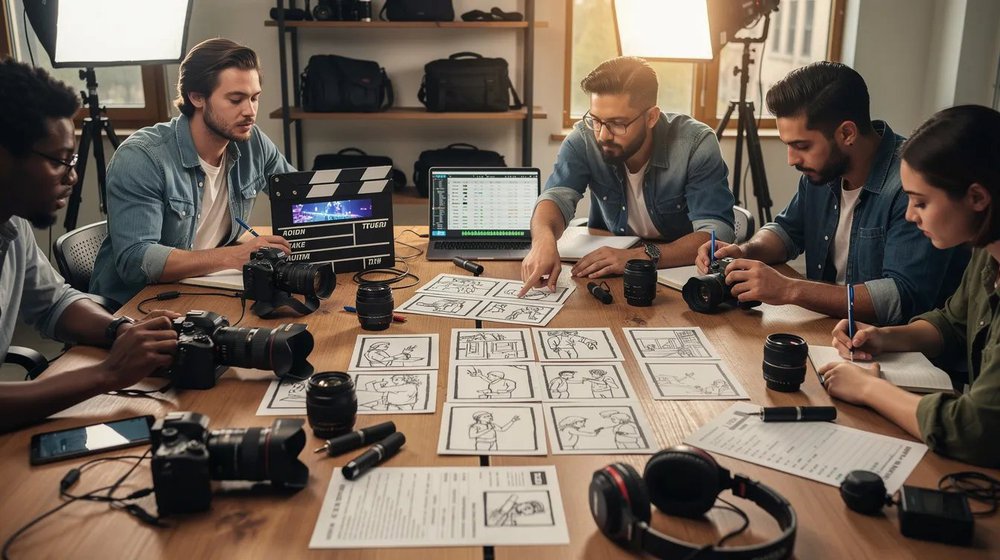
Most B2B teams approach video reactively. A product launch comes up, someone requests a video, and the team scrambles to produce something in time. That approach works once. It does not build a library, a system, or a competitive advantage.
A real B2B video marketing strategy starts before production begins. It connects your business goals, your buyer journey, your sales process, and your measurement plan into one coherent video content marketing plan.
Here is how to build it.
Set Goals and KPIs Before Production Starts
Every video should have one primary job. Not two, not five. One.
That job might be increasing demo requests from a specific landing page. It might be improving the conversion rate from marketing qualified lead to sales qualified lead. It might be helping sales teams close faster by giving buyers something to share internally after the call.
Once you know the goal, the metrics follow naturally. Some of the most useful ones to track in B2B video marketing include:
- Watch time and completion rate
- Click through rates on in-video or post-video CTAs
- Form fills and meetings booked
- Pipeline influenced
- Win rate lift in deals where video was viewed
Define Your Buying Committee, Not Just Your Buyer Persona
Most B2B video strategies are built around a single buyer persona. The problem is that most B2B deals are not made by a single buyer.
The average enterprise purchase involves multiple stakeholders, each with different priorities and different objections. In tech and SaaS, that might look like this:
- IT wants to know about security, integrations, and implementation
- End users want to see that the product is intuitive and saves them time
- Operations wants proof that it fits into existing workflows
- Finance wants to understand the return on investment and total cost of ownership
- Leadership wants confidence that this is the right long-term decision
A single marketing video cannot speak to all of those needs at once. But a well-planned video library can. FAQ videos, demo chapters, customer testimonials, and short comparison clips can each be built to address a specific stakeholder concern, giving your sales teams the right asset for every conversation.
Match Format and Budget to Funnel Stage
Not every video needs the same level of production. Spending your entire budget on one polished brand film while leaving your consideration and decision stages empty is one of the most common mistakes B2B marketing teams make.
A practical way to think about it:
- Top of funnel content like thought leadership clips and social videos can be produced quickly and at a lower cost. Speed and consistency matter more than perfection here.
- Mid funnel content like explainer videos and product demos needs clarity and quality. This is where animation, motion graphics, and professional production start paying off.
- Bottom of funnel content like testimonial videos and case studies needs careful planning. These assets directly influence revenue, so the investment is justified.
When it comes to format, animation works well for abstract concepts, complex workflows, and products that are hard to film. Live action builds human connection and trust. Mixed media combines both and works especially well for B2B brands that need to balance technical credibility with emotional storytelling.
Distributing B2B Video Across Channels for Maximum Reach

Producing a great video is only half the work. Where you put it determines whether it actually reaches the right buyers at the right time.
Your website is the highest-intent destination you have. Embedding video above the fold on key landing pages gives buyers an immediate reason to stay. Pages with video keep visitors on site an average of three times longer than pages without, which also sends positive signals to search engines.
On LinkedIn, native video uploads consistently outperform link posts in reach and engagement. Short clips with captions and a clear point of view work best. YouTube is a longer game, explainer videos and product walkthroughs build search-based discovery over months and years.
For email and sales outreach, incorporating video thumbnails to a sequence can improve click through rates and meeting bookings. For high-value accounts, a personalized intro layered onto a core demo or explainer adds relevance that generic copy cannot match.
And do not overlook events. Looping brand reels and product walkthroughs at trade show booths create conversation starters without requiring your team to pitch constantly. Recording sessions also gives you content to repurpose long after the event ends.
Measuring ROI From B2B Video Content
Views are a starting point, not a success metric. A video is working when it changes buyer behavior, not just when people watch it.
Split your measurement into two categories:
- Engagement metrics tell you how the content is landing: watch time, completion rate, drop-off points, and replays.
- Business metrics tell you whether it is driving results: demo requests, form fills, click through rates, pipeline influenced, deal velocity, and win rate in opportunities where video was viewed.
Use UTM links, dedicated landing pages, and CRM attribution to connect video viewership to actual pipeline. Talk to your sales teams regularly. Ask which videos prospects bring up on calls. Ask which assets helped move a deal forward or handle a specific objection.
That qualitative feedback is just as valuable as the data. It tells you which video types to prioritize next and where the gaps in your marketing content strategy still exist.
When to Work With a B2B Video Production Company

Some video projects are manageable in-house. Others carry enough risk and complexity that bringing in a production partner is the smarter move.
The clearest triggers are moments of high stakes: a product launch, a rebrand, a new market entry, or a full sales enablement push. These are situations where a disconnected or low-quality video does real damage to how buyers perceive your brand.
A good B2B video production company brings strategy, scripting, creative direction, animation, and project management into one coordinated process. That means fewer revisions, faster turnaround, and a final product that maps to your actual business goals.
Levitate Media has spent 16 years and 10,000+ videos helping B2B companies build video libraries that work across marketing, sales, and customer success. One shoot becomes many assets, all planned from day one.
If you are ready to turn video into a measurable growth asset, talk to a video expert or get a budget estimate to start scoping your next project.
Insights from